
-
followus otaku usa rss feed otaku usa twitter page otaku usa facebook page
otakusearch5
Anime
TOP STORIES
The Vault of Error: SteamboyThe Vault of Error: Steamboy
Dynamic and highly divisive
The Hunter x Hunter Anime Fights On!The Hunter x Hunter Anime Fights On!
We take a further look at the new series
Studio Ghibli's Ocean WavesStudio Ghibli's Ocean Waves
The “Lost” Ghibli Film Arrives in the U.S.
The Vault of Error: Magnos the RobotThe Vault of Error: Magnos the Robot
Equal parts amazing, lame, imaginative, and stupid
Golgo 13: Queen BeeGolgo 13: Queen Bee
Come Back, Pumpkin Joe
Dragon Ball Z Level 1.1Dragon Ball Z Level 1.1
Kame... hame... HD!
Trigun: Badlands Rumble Blu-RayTrigun: Badlands Rumble Blu-Ray
A release worth your hard-earned double-dollars
Highschool of the DeadHighschool of the Dead
Romero by way of anime
Chrono CrusadeChrono Crusade
This pair has more than a few screws loose
More...
The Vault of Error: Taro the Dragon BoyThe Vault of Error: Taro the Dragon Boy
A harsh fairy tale without the safe Disney coating
The Vault of Error: GeobreedersThe Vault of Error: Geobreeders
Attack of the shape-shifting phantom cats!
The Vault of Error: Darkside BluesThe Vault of Error: Darkside Blues
Where high tech and low life collide
The Vault of Error: Bottle FairyThe Vault of Error: Bottle Fairy
A bottle of questionably-aged cute
More...
Youmacon 2011: The Voices Behind AnimeYoumacon 2011: The Voices Behind Anime
Death Note's Light, DBZ's Krillin and more!
Yasuhiro Imagawa 2: Imagawa HarderYasuhiro Imagawa 2: Imagawa Harder
Another interview with the anime great!
Elfen LiedElfen Lied
More than just a splatter show
The Bizarre Politics of GasarakiThe Bizarre Politics of Gasaraki
Is this supposed to be entertaining?
More...

Dreams Grown Red and Black
Hayao Miyazaki's Evolving Imagery

by Paul Thomas Chapman
Add This

Be the first of your friends to like this.


Posted 2/16/2010

fp-pon_115

Hayao Miyazaki is his own fiercest competition. Even though his films have captured the hearts and minds of audiences both in Japan and abroad, even though Miyazaki's career as a film-maker spans decades, even though his influence in the world of Japanese animation is second only to Osamu Tezuka, even though he has rightly earned his place as a titan within the industry, I often examine his latest works and find them wanting. What element in Miyazaki's most recent films has left me in the cold? In a word, it's the imagery.

Princess Mononoke was a milestone in Miyazaki's career. It was the first of his films to see an American theatrical release, and it was the first Miyazaki film to incorporate computer graphics into the production. But it was also a turning point thematically and artistically. Mononoke is where Miyazaki's imagery took a turn for the cynical. Mononoke is not the only Miyazaki film to portray humanity violently at war with the environment; that laurel belongs to Nausicäa of the Valley of the Wind. On the surface, the two films share such similarities as fantastical settings, strong female characters, and morally ambivalent antagonists. But the consequences of the acts of violence in Nausicäa remain largely implied, the strongest example being a few drops of blood dripping off of a sword used to assassinate a king. Compare that to what transpires in Princess Mononoke: a musket bullet passes completely through Ashitaka's torso, bursting out of his back in a spray of blood. Arrows accidentally empowered by a supernatural curse decapitate and dismember Ashitaka's foes. Lady Eboshi's flintlocks strew the battlefield with maimed and mutilated samurai. Weirder still, some of these violent scenes are played for laughs. Can this really be the work of a director renowned for the gentleness and humanism of his films? What has happened here?

b-MononokeHime

Images of blood and gore are not the only imagery that have evolved into something darker in Miyazaki's films. After all, Mononoke is an anomaly, the only example so far of Miyazaki's creations that merits a PG-13 content rating. In these films violence and bloodshed is the exception, not the rule. The specter of pollution, both of the physical and spiritual varieties, is a much more common trope. But post-Mononoke, Miyazaki has taken the gloves off regarding pollution imagery. A few bits of litter in an otherwise clear forest stream in My Neighbor Totoro or the smoke-spewing chimneys in Kiki's Delivery Service remind the viewers of humanity's impact on the world. In recent efforts, however, goo is king. Slime, muck, oil, and ooze – these are the images Miyazaki uses to express the malignancy of pollution. Whether it's the tentacle-infested tatari-gami of Mononoke, the burbling Stink Spirit of Spirited Away, or Howl's slime-slathering tantrum in Howl's Moving Castle, the images of pollution have become more immediate, more threatening, and much more repulsive.

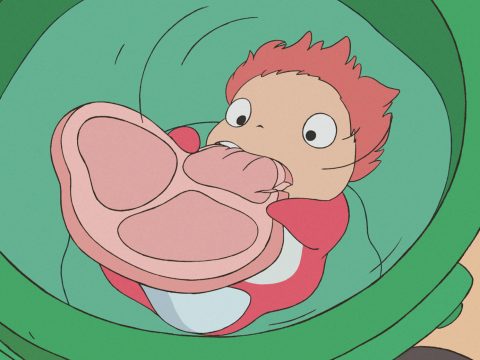
Even Ponyo – with its return to a gentler aesthetic and less complicated themes – contains imagery that I can only describe as troubling given the director's previous work. Miyazaki's feminism is well established. In a medium plagued by shallow and often negative depictions of women, Miyazaki's female protagonists are usually strong, independent, and replete with positive qualities. And while I see some of this in Ponyo's rebellious and headstrong personality, I also see a film that is essentially an enormous, phantasmal arranged marriage – a film in which the women are defined entirely by their roles as wives and mothers, in which the parents go off to discuss the nuts and bolts of the nuptials while the children play. When Ponyo presents a young mother with a sandwich and demands that she “make lots of milk” for her baby, I don't know whether to be amused at Ponyo's antics or puzzled by what they might imply...  

b-pon_118

The experience of Miyazaki's films can often be condensed down into sequences of imagery of such transcendent emotional power that they can move a man to tears. In My Neighbor Totoro, a friendly forest spirit invokes a magical dance to make tiny seeds sprout into an enormous camphor tree with mighty branches that spill across the sky. Then the titular Totoro takes to the air on a spinning top and his joyous bellowing becomes the wind that rustles the rice paddies at night. In Porco Rosso, the spirits of slain biplane pilots form a river of aircraft that meanders into the Heavens. In Castle in the Sky, a young girl floats to Earth as gently as a bit of dandelion fluff, protected by the glow of her magic amulet. Recalling the elegant beauty of these scenes brings tears to my eyes. Where are these images in Princess Mononoke, in Howl's Moving Castle, in Spirited Away? Miyazaki may have earned his Academy Award, but I'd trade all the bile-spewing, rampaging, faceless ghosts and grotesque parents-into-pigs transformations in the world for one more ride on the Nekobus.

It is dangerous to assume that the director of a film is entirely responsible for everything that appears on screen. But Hayao Miyazaki is a prodigious and prolific creator, not only serving as director but also screenwriter, producer, and chief animation director for many of his films. Perhaps this workload is too much for any one man, even a visionary like Miyazaki, to shoulder. When I see images cribbed from his own earlier works, such as Mae's tunnel-to-wonders scene from Totoro turned into a sinister parallel in Howl's Moving Castle, I have to wonder if age and experience have tinted Miyazaki's visions with a darker shade of pessimism.

b-spirited_away_05

Princess Mononoke is © NIBARIKI-TNDG © Buena Vista Home Entertainment, Inc.

Comments:

>> Yarnspinner (Monday, March 07, 2011)
I feel the author of this article is a bit too quick to judge the darker tones of Princess Mononoke. While it is considerably more violent than other Miyazaki films, it has plenty of gentle, elegant, touching and emotional scenes (The scene where San feeds Ashitaka in the forest, for example.) I've seen all of his films and Mononoke is easily my favorite because of it's wide range of emotional implications mixed with it's unnerving scenes of bizarre scenes of darkness and destruction. The point is to appreciate the beauty hidden within the dissonance. I think this author has really missed out on that and seems to only appreciate uncontrasted elegance. But, such consonance and beauty are much more meaningful when they are surrounded by relative ugliness. I'd rather be taken on a journey and shown a variety of deeply contrasting scenes than just two hours of pretty, agreeable, pleasant paintings. I love all of Miyazaki's films. But, I, personally, think Princess Mononoke is some of his greatest work. I don't believe Miyazaki is trying to portray a more pessimistic view. Rather, I think, he is trying to show that things aren't always beautiful and pleasant, and that the few moments of comfort and elegance should be more appreciated. He's not becoming more pessimistic, in my opinion. He's becoming more expressive.
>> Adri (Tuesday, May 25, 2010)
I think Hayoa Miyazaki's Sweet themes and light colors are good. But I bought 3 and didnt watch them for a few months. My faveriote 2 shall always be Kiki's delivery Service and Howl's Moving Castle. I would call them more American style then the are "anime" No doubt that the are sweet and very good films, Miyazaki is a good cartoonist. But its a hit and a miss for him. I personally think Miyazaki's Monoke-hime is alittle long and its a rather odd story with not a very good ending in my opinion. There are diffrent hits and misses with him so its difficult to tell, But Ponyo is very nice and sweet, It's something a 13 year-old would like and a 4 year-old would think it be cute. It's one of Miyazaki's signature themes such as Kiki's dilivery service. I have never looked into his manga but maybe it shows a diffrent side of him.
>> Dallas Marshall (Tuesday, April 13, 2010)
Miyazaki, to me, seems to be losing his touch in the department of storyline (Howl's Moving Castle was subpar at best), but in the realm of cinematic quality in the realm of visuals. Miyazaki is still the best and even still has some of the heart that he left in the past that still pulls on the heart strings. I felt Spirited Away had a few scenes which could move me to tears. I like your analysis, its shows you love to dissect films. Just like me! Keep up the good work!
>> Sakura (Friday, April 02, 2010)
Even though Miyazaki's films can be a little strange to be called family/kids movies, I think the imagination behind it is fantastic. They are like one of those timeless things, like Disney, that can be passed down and recognized throughout generations. I just only hope if he does continue to make movies, after Ponyo, that they be just as epic and adorable as the previous before.
>> haku (Sunday, March 28, 2010)
hola soy haku .de argentina .no encontre las palabras o no encontre el sentido de la explicasion .pero solo puedo decir mi umilde opinion, la opinion de una persona comun talves .el solo nombre deL SENSEI AYAO MIYASAKI lo dice todo.
>> jagen heie (Friday, March 05, 2010)
could it possibly be that when he started he was trying to show how were having an effect but since then no ones listened and we are creating more and more of a negative effect that he feels the need to show this on screen?
>> Densityduck (Sunday, February 28, 2010)
Just to nitpick, the "slime tantrum" scene in HMC was present in the original work. Although you could then say that this just goes to show the truth of the assertion; given how the book got such a pick-and-choose treatment to make the movie, it's probably meaningful that Miyazaki kept that scene.
>> Jessica (Monday, February 22, 2010)
My toddler's favorite film is Princess Mononoke. Second is Porco Rosso, though it's a tie with Howl's Moving Castle. I've decided that he should not be watching Castle in the Sky or Nausicaa because they are extremely loaded with violent scenes. There's violence in the first three as well, but in PM and HMC there is logic and sense to it. Despite it's PG-13 rating, I prefer my 2 year old to watch Mononoke for the environmentalism, and in the hopes that he will take after Ashitaka as a champion for fair, balanced, and well-considered behavior.

As was pointed out in a comment on the article, there is a great scene with Ashitaka and Moro at the wolf tribe's cave. She wolf goddess angrily speaks about biting his head off and her rage at the boars and the humans and the cries of the trees. Ashitaka calmly ignores her rage and speaks to reason, deflecting her nastiness that he never earned. You also mention the bullet that fires straight through him (on accident), but Ashitaka is undeterred in his goal in trying to end the fighting. "Why can't the humans and the forest live in peace?" It's a beautiful message, and while you might find it to be a downer, I see a role model for hope in Ashitaka and perhaps even in Mononoke herself.

I will grant you that Miyazaki is overly generous with the females and less than generous with the men. Ashitaka is the only truly handsome man that gets any screen time in the film, yet the women have very few physical flaws. Even Eboshi is stunning.

What you seem to miss, also, is that Miyazaki shows the ambitions of every side in the film are both self-satisfying and philanthropic in some capacity. Eboshi wants to get rid of the forest gods, true, but she wants to help the lepers and get women out of brothels and provide a safe and secure home for the men, all of whom can make a living off natural resources. Mononoke wants to kill the humans for their damage to the environment, but when it comes down to the wire, she decides instead to forsake vengeance in order to do what's right for the majority (finding and returning the head of the Forest Spirit). Jigo and Lord Asano are a little flat and conniving as characters, I'll grant you, but even Jigo has his good parts--they just conveniently help himself in the process. Ashitaka only gets involved because he's got the whole curse thing going on and decides to live like he's dying, but he really does want there to be peace. Even the Forest Spirit is guilty of healing Ashitaka's bullet wound but leaving the demon mark to fester, as though he wanted to encourage Ashitaka to fight for him (as he does) to earn a healing from his curse.

So, you know, I like the film.
>> Dimitris, Austria (Monday, February 22, 2010)
Dear Paul, regarding Miyazaki's "elegant beauty scenes" that you seem to miss, I hereby note my personal opinion:

Howl's Moving Castle> 1. Howl flywalks with Sophie above the crowds. 2. Howls shows Sophie the door to the garden landscape 3. Sophie discovers Howl's past.

Spirited Away> Many brilliant scenes here, meant to deliver classic fairy-tale memories. Very touching: Chihiro's and Aku's flying scene.

Especially about Nausicaa and Princess Mononoke, I have to disagree with you: the fact alone that someone devotes such brilliant works to present humanity's relation with Nature "brings a man to tears". Many scenes to recall here, practically 90% of the movies. The absolute touchiest in my opinion:
Princess Mononoke> 1. Ashitaka sees Mononoke and the wolves by the river, 2. Ashitaka wakes up and talks with the Wolf goddess under the moonlight, 3. The God of the Woods takes back its head.
Nausicaa> 1. Nausicaa exploring the poisoned joungle, 2. Lord Yupa arrives to the Valley of the Wind 3. emergency landing in the poisoned joungle, 4. Nausicaa discovers the actual purpose of the poisoned joungle, 5. Nausicaa tries to stop the wounded baby Olm from being transported to the Valley.

Keep up the good critics!
Dimitris
>> Reggie (Friday, February 19, 2010)
Hello Paul,

I'm a fan of your podcast so I'm used to your discourse, but it's great to read one of articles as well, especially since I'm not used to hearing you talk about more renowned and mainstream works. Your thesis is definitely sound, though I would suggest you watch Miyazaki's tv series directorial debut with Future Boy Conan - the cynicism started there, but not without hope. I think what you refer to as Miyazaki's pessimism may just be his artist's struggle to show people hope in a hopeless world. Also, I strongly suggest reading his collection of essays in "Starting Point" since I think it may shed a light on your criticism. Any chance that GME will cover one of his films?

Add a comment:
Rules: 1) No excessive profanity. 2) No 1-2 word comments. 3) No gigantic streams of letters or punctuation marks.
4) You are free to respectfully disagree, but personal attacks will not be tolerated.
5) Do not spoil major plot points for other readers (i.e. OMG I CAN'T BELIEVE DARTH IS LUKE'S FATHER!)
6) Please do not click "Publish Comment" more than once.
If you break the rules we may be forced to edit or delete your comment, sorry!
CAPTCHA Validation
CAPTCHA
Code:

Subscribe to Otaku Magazine
Current Issue
Bonus Content
Free Stuff

Anime | Manga | GamesEvents | J-Pop | Store | SubscribeAbout | ContactForums | BlogCurrent Issue
OTAKU USA ©2011 All rights reserved.