
 Daryl Surat
April 16, 2010
Daryl Surat
April 16, 2010 “A hapless, average guy finds himself surrounded by beautiful women, all of whom love him inexplicably for simply existing and have one or two defining personality traits. The guy lacks the backbone to pick just one girl, so he’s content to keep things as they are, such that as situations develop, he can be around all the characters as they exhibit their personality traits. If he accidentally touches one of the girls or sees them in a state of undress, then he is met with physical violence. When things start getting stale, just introduce another girl.”
Over the decades, the above has become the template for a glut of anime romantic comedies and dramas, enough such that fans in America coined the informal term “harem anime” as a catch-all to describe them. But where did this all begin? For my money’s worth, the REAL answer is Kimagure Orange Road, as that defined all of the character archetypes, situations, stock gags, and so on that makes the entire harem genre absolute garbage. But KOR apologists, too blind to see that the show they adore is actually utter trash, will deny this charge on the grounds that there are only TWO girls the wimpy milquetoast guy can’t decide between in that show. As such, the most commonly agreed-upon origin of the “harem anime” is the 1980s anime series Urusei Yatsura (roughly translated, “Those Obnoxious Aliens”), ostensibly based on a manga series by Rumiko Takahashi, creator of such mega-popular series as Inuyasha and Ranma ½. But I got news for you: anyone who makes that claim is flat-out wrong. Urusei Yatsura isn’t the first “harem anime.” It’s the anti-harem anime, preemptively made before harem anime existed, and it remains one of the best anime ever.
The basic formula for UY: take a classic Japanese mythological tale or creature and render it as a crazy guy or a cute girl. Then unleash them on the third stone from the sun and let the hijinks ensue. Mob chase scenes, widespread destruction, countless puns, facefaults, and slapstick domestic violence—remember, against guys only because it’s only funny when MEN get physically assaulted!—are the norm in this series, which defiantly gives continuity the finger as our “hero’s” house is routinely destroyed, only to be perfectly rebuilt and fine a few moments later. If you’re expecting a story, look elsewhere. Crayon Shin-chan is commonly described as “the Japanese version of The Simpsons,” but Urusei Yatsura to me is the Japanese version of The Simpsons back when that show was still good.
It doesn’t take long to end up with quite a few cute girls, but here’s the principal difference as to why Urusei Yatsura is not a “harem” show: the reason the so-called “harem” exists in those shows is because the main character never seems to try and score with any of the women fawning over him, not even the one who’s positioned as the “obvious” choice. To do so would imply the presence of a distinct personality. That makes it harder for the otaku viewer to mentally substitute themselves in for the blank slate male lead. Some notable examples in recent years have bucked this trend, but they’re not intentionally comedic.
Urusei Yatsura, as the predecessor to “harem” anime proper and an era in which otaku were the primary demographic for anime, has a male lead that’s the polar opposite of all that: Ataru Moroboshi, the most lecherous teenager on the planet. True, he can’t pick one girl. But that’s because he wants ALL the girls, and no matter what Neil Strauss says, when you’re the kind of guy Ataru is, hitting on every girl you see just means you get rejected by every girl you see.
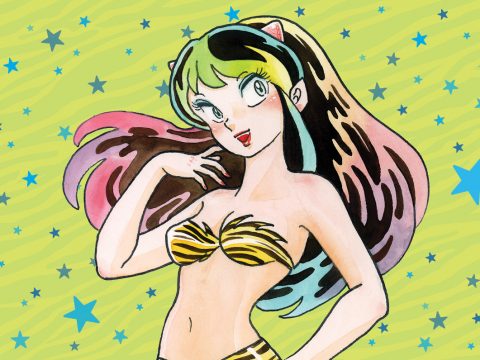
All the girls HATE him, with the exception of one. For as a further example of his terrible luck—his name roughly translates to “get hit by a falling star,” one of the aforementioned countless puns—Ataru finds himself forcefully hitched to Lum, the green-haired princess of an alien race known as the “Oni.” Like the mythical creatures, Lum has horns and wears tiger-striped clothing, except instead of being a scary ogre like her dad she’s a cute girl with green hair who wears a two-piece, tiger-striped bikini as her default outfit. Between her revealing attire that guarantees she’s on pretty much every bit of official Urusei Yatsura artwork and Stevie B’s anime con evangelism, Lum is far, FAR more famous and well-known than the series in which she originates.
That’s quite unfortunate, since Lum quite frankly is the least entertaining character in the entire series. Oh sure, she can fly and shoot lightning when she’s either veryhappy or very upset (which she gets whenever she sees Ataru trying to cheat on her, so every episode), but her main purpose in the story is to get the ball rolling for the story by way of her having some sort of random alien invention or there being some character that’s interested in her. Lum is not funny herself and after a few minutes, it doesn’t even register in your brain that she’s wearing either a bikini or a schoolgirl uniform. However, she enables everybody ELSE to be funny.
Lum’s friends and relatives are a cadre of wacky aliens with their own bizarre traits based on “fractured fairy tale” style interpretations of classic Japanese myths. Ataru’s classmates, teachers, and parents are greedy, fanatical, and prone to violence or general mental instability. Hey, you’d go crazy too if you had to keep track of that many love triangles! Much like the supporting cast of The Simpsons, you can sum up everyone’s character in pretty much one phrase. The Prince of the Underground: his talent is DIGGING HOLES! Ryuunosuke: she’s a girl who was raised as a boy by her jerk dad, so hardly anyone realizes she’s a girl! (Note: just like the girls in the show, female fans of Urusei Yatsura LOVE Ryuunosuke.) There may not be an ongoing narrative, but everyone’s developed just enough such that by the time the writers come up with a situation, they need only drop these characters in and the episodes practically write themselves. The first ending credits song sums up the writing approach: “let’s put weird and weird together, and make it even weirder!”
Truly, these aren’t the typical scenarios you see reused today so often in actual “harem” properties. As the anti-harem anime, Urusei Yatsura had CREATIVITY. One episode was about the banning of leaving school campus to get lunch, thus resulting in a city-wide war between truants and faculty. A PTA meeting results in intergalactic war, the peace negotiations of which were settled by a roulette gamble. Contracting space cavities means the only way to slightly alleviate your pain and general zombie-like state is to bite someone else, thus giving THEM space cavities. A space taxi driver gets stiffed on his fare, so he steals all of the world’s oil. A rich girl accompanied by an army of kabuki stagehands holds a masquerade ball where everyone ends up fighting it out as they race to the goal. Heck, one episode is a straight-up Agatha Christie homage in which everyone gets invited to an island mansion and gets KILLED one by one! No “harem” show since ever came CLOSE to this level of inspired brainstorming. They all banked instead on emphasizing the pretty girls. They just don’t get it: Lum isn’t what makes the show completely awesome. Yes, she is literally the poster girl of the series, and without 2D and 3D people alike being drawn to her there would be no show as these situations wouldn’t come to pass, but that isn’t enough to make people stay interested for long.
I know she created it, but I just can’t credit Rumiko Takahashi for Urusei Yatsura being so great. For despite the fact that many of the TV scenarios were originally in the manga, her characterizations were off. Not only are some of my favorite characters in the series not even in her manga, she made her version of Lum pretty much a psycho hose beast. This in turn is how she’s depicted in the earliest episodes of the anime, and this along with the now-dated animation turns people off big-time. It wasn’t until about 20 episodes in when series director, a then-fledgling guy by the name of Mamoru Oshii, changed Lum’s character to be nicer and more sympathetic against Takahashi’s will that the popularity of Urusei Yatsura really exploded. The animation budget rose dramatically, and even though the stories began to diverge greatly from the manga, Rumiko Takahashi became a superstar by association. UY was a reasonable manga hit after a slow start in 1978, but it wasn’t until 1982—four years later, mind you—when Oshii started to make it his own that it became a MASSIVE hit. So despite my liking the short stories of Rumiko Takahashi, many of which she wrote at the same time as Urusei Yatsura to make ends meet, I can’t help but think that Mamoru Oshii was the one to credit for her rise to superstardom.
The average length of a modern anime series is 13-26 episodes, and most of those can’t sustain their premises for even that long. Urusei Yatsura ran for 195 TV episodes, 11 OAVs, and 6 movies. It was also the first anime series to really spend BIG money on the music; the full collection of all the vocal songs and background music spans 15 non-singles compact discs! It’s a colossal production, and all of it was released on DVD in America, making it the single longest anime series to be brought out in its entirety in the US. Of all that, Mamoru Oshii, who later went on to direct more serious fare such as the Ghost in the Shell movies, directed over 100 episodes as well as the first two movies. The second movie, Beautiful Dreamer, is commonly hailed as one of the single best anime films of all time. People correctly note that film is a drastic departure in tone from the typical UY source material, but it’s not a total anomaly. There are some serious, surreal episodes mixed in amidst the screwball chaos. After Oshii left in 1984, his successor Kazuo Yamazaki put the remainder of the series on a much more sentimental route. The characters kind of paired up and mellowed out a bit, but there were still some great episodes and the follow-up TV episode length OAVs are good stuff. I particularly liked the OAV “Catch the Heart,” where the gang finds candies that, once eaten, cause a heart to appear above your head. Grab someone’s heart, and they fall madly in love with you!
I think when it comes to Rumiko Takahashi, whichever series of hers you see first is typically the one you end up liking the most. After reading Usenet as a teenager, I intentionally watched Urusei Yatsura first so I wouldn’t end up like those annoying Ranma ½ posters. To this day, Ranma just isn’t funny enough to me. It started off as a parody of shonen action/adventure series, but went on for so long that it became exactly what it was making fun of. Inuyasha purported to have an ongoing narrative, but little happened in the way of progress such that the finale was so rushed that hardly anyone still cared by the time it happened. Yet everyone I know loves either Ranma or Inuyasha as Urusei Yatsura and Maison Ikkoku remain relatively forgotten. It’s because the former are what they saw first, or at all. Personally, I blame that early set of UY episodes which were lower in budget (they definitely look their age!) and more faithful to Rumiko Takahashi’s manga.
If you want to learn more about Urusei Yatsura, go to the website I went to decades ago in the early days of the World Wide Web: Tomobiki-Cho. It’s still there and it’s still the best English language resource on the series there is, bar none. While you’re at it, this is an open invitation to head to AnimEigo to get the DVDs. Sure, there are over 60 DVDs, but they’re $8 each nowadays. There was only one series quite like this one, and though many have tried to replicate its winning formula over the years, none quite succeeded.
Related Posts