

 Julian Gnam
September 22, 2009
Julian Gnam
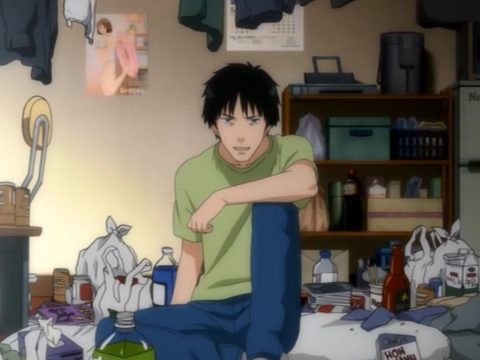
September 22, 2009 If you’ve ever spent a semester in college and suffered a fit of procrastination, you have probably felt exactly like this series’ protagonist, Satou Tatsuhiro, on some level or other. Pressed with the stresses of college classes and the outside world, and left on his own without interference from his parents, he just stopped going to class for a while. Spending every day shut in his apartment, sleeping till late hours of the afternoon, consuming junk food, beer, cigarettes, manga and tv, entertaining vague notions of employment that will never materialize – facing the real world consequences of his life style became too much to deal with. Now he’s allowed his social insecurities to continue brewing to the point of paranoia, and he knows he has to break out of it… but how?
Conveniently, he runs into Misaki Nakahara, a young girl who claims she can cure him of his “hikikomori” condition. But in an attempt to impress her, he takes on a game design project with his next door neighbor Kaoru Yamazaki, who worsens his condition by introducing him to more nerdy hobbies he can lose himself in. The trio of young outcasts band together to overcome their social issues, but as Satou’s journey to self-improvement becomes a roller coaster ride of repeated drops into the depths of otaku self-indulgence, it’s not clear whether they will ever succeed.
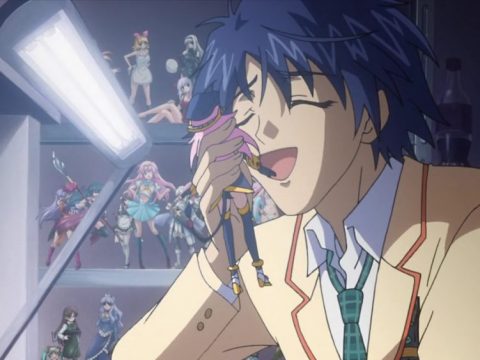
Welcome to the NHK is part of a long line of “meta-anime” like Otaku no Video and Animation Runner Kuromi which takes on otakudom itself as the subject. You could show this to family and friends who aren’t into anime or manga at all as a sort of primer on what the hobby is like. The protagonists are attempting to start a game design company, discuss the virtues of anime character design, visit maid cafes, collect moe figurines, have huge manga collections, and suffer bouts of addiction to both MMO’s and hentai…it’s all there. In what is undoubtedly the cleverest aspect of the series, it points out and pokes fun of all of the over-used clichés and conventions of anime, manga, and games, while simultaneously employing those very conventions itself to advance the plot, right under your nose, in such a way that you don’t notice its hypocritical nature. Unfortunately seeing such a worts-and-all portrayal of the subject might only increase the concern outsiders have for your well-being, and the number of interventions which are staged on your behalf – so do it at your own risk!
Welcome to the NHK is at once very psychological and very silly. Each of the prominent characters has their own personality disorder or set of psychological issues which causes them to eschew the outside world. One character is borderline schizophrenic, his highschool crush is a conspiracy theorist, and another character is a classic anime/manga/game nerd. Peripherally the series covers suicide clubs, MMORPG addicts, and even pyramid marketing schemes. However serious these issues are and how dramatically they are portrayed, they are simultaneously handled in a light-hearted manner and used to construct hilarious gags. One could almost compare Welcome to the NHK to a somewhat more serious and slightly less perverted Golden Boy. Fan service and masturbation jokes come at you at a mile a minute, and yet in the midst of all this silliness, you are actually given a rather accurate and realistic look at the each episode’s subject matter.
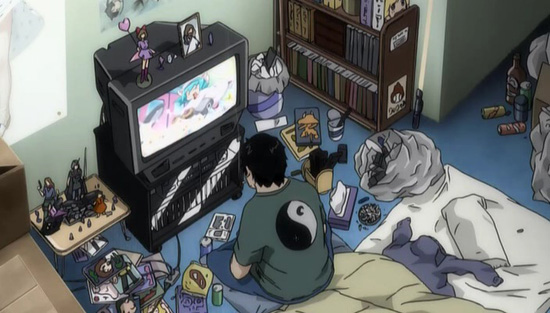
It’s possible some would take offense at the show, feeling that their perfectly valid lifestyle is being criticized as a psychosis, but one has to admit that at least some of the world’s most hardcore geeks must be driven by the very issues which this show makes the center of its story. No matter how proud you may be of your stellar mental health in the face of constant anime-watching, manga-reading, and gaming, you WILL still have found yourself in many of the situations which are the butt of this series’ jokes. This is a series about otaku, for otaku, by otaku and there’s no way it could detail the lives of hikikomori so accurately unless the creators had been otaku themselves.
Lastly, I think it’s worth mentioning that Welcome to the NHK is psychological in a very direct way that popular psychodrama series such as Neon Genesis Evangelion or Serial Experiments Lain aren’t. The viewer is never left guessing as to the meaning of a scene or forced to real conspiracies or supernatural encounters in NHK,everything that happens could have happened to you. As a result, despite all the silliness, despite the fact that you’re watching cartoon characters and wacky stuff happens, it feels very real – and not in a posturing gritty way either.
Welcome to the NHK is most definitely worth a watch. It’s equal parts a psychological critique of the hobby and a slapstick/situation comedy. It keeps you laughing while staying just dramatic enough that you’re glued to your seat itching to find out what will happen in the next episode. It deals with subject matter that every otaku can relate to, in a way that few other series have really touched on before. It is unique and original, it has a serious side with some implications on how real people live their lives, and yet it never really feels morbidly serious. Give it a shot.
Publisher: FUNimation
Rating: Teen
Available: Now
Related Posts


![Doc Big in Japan Offers A Guide on How (or How Not) to Get Famous in Japan [Review]](https://otakuusamagazine.com/wp-content/uploads/2018/07/biginjapan01-480x360.jpg "Doc Big in Japan Offers A Guide on How (or How Not) to Get Famous in Japan [Review]")
