

 Daryl Surat
October 18, 2010
Daryl Surat
October 18, 2010 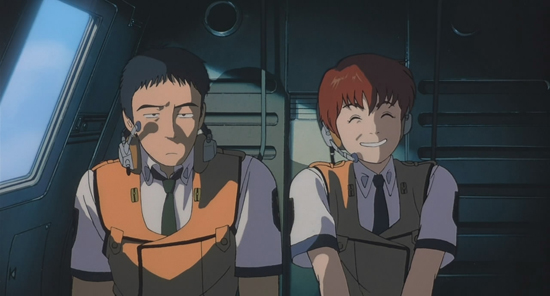
Between Birdy the Mighty: Decode and having designed the new Vocaloid character Gumi—aka “Megpoid” due to her voice being provided by Megumi Nakajima, best known for being Ranka Lee in Macross Frontier—Yuuki Masami has experienced a sort of popularity resurgence within the last few years. But his greatest achievement dates back to over twenty years ago with his membership in an artist group known as Headgear. A group that also included director Mamoru Oshii (Ghost in the Shell, The Sky Crawlers), Yutaka Izubuchi (RahXephon), writer Kazunori Ito (the .hack// series… forgive him), and noted character designer Akemi Takada (Urusei Yatsura, Maison Ikkoku, Kimagure Orange Road), Headgear was a seriously elite gathering of talent. Unlike other artist groups such as CLAMP, their anime output as a collective was fairly low, having only created one big hit title, but what a title it was: Mobile Police Patlabor. When I say “big hit,” I mean sales of the series reached 1,000,000 copies in 1992, before DVDs even existed! These days a “big hit” is something that sells 70,000-150,000 copies.
If I was forced to name one and ONLY one anime title that I believed represented all of the best things that anime had to offer, I would certainly have a hard time doing so. But in the end, I would probably pick Mobile Police Patlabor. No other anime has ever demonstrated as high a level of versatility with as high a level of competence.
Anime fans always say to non-anime fans that the reason they like anime is because of its lack of limitations in what stories it can tell, or its penchant for strong characterization and relationships. But the anime industry’s economic situation has imposed artificial limitations on those things, resulting in a sharp decline in risk-taking and an ever-compounding consolidation of genres. Patlabor dates back to a more prosperous time, back when “the future” was still looked at with optimism and a “nothing impossible” attitude, to use a phrase from the original theme song. So it was that when Yuuki Masami was developing Patlabor he asked “I wonder if it would be possible to make a robot anime that was different from the other shows—a show that wasn’t overly zealous in its depiction of war and conflict. How about a robot anime that would cheer up the people watching it?” The episodes would often include a disclaimer that “this is a work of fiction… but in ten years, who knows?” I imagine now that it’s been 20 years and the year 2000 came and went without giving us “the future,” new viewers of the series in 2010 may not quite have the same hopes.
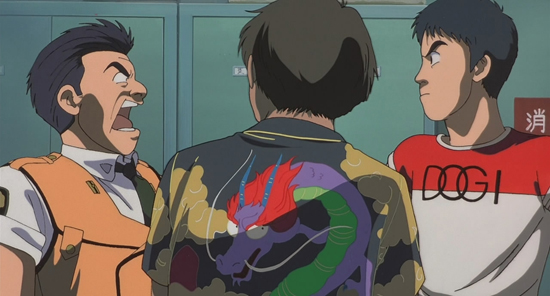
Patlabor is presumably set in a Japan of “ten years in the future” as envisioned by people in the late 1980s/early 1990s, so videocassette tapes are still common while cellular phones and the Internet aren’t particularly embedded within every facet of life. In this world not too far removed from the then-modern day, advances in technology enabled the creation of a new form of construction equipment known as “Labors.” Labors come in all sorts of varieties depending on the task they are built for, but most are humanoid robots of roughly the same size as a typical real-world construction vehicle. Japan primarily employs Labors in a massive public works program known as the Babylon Project [a dream given form…] that, when completed, will convert Tokyo Bay entirely to land in order to accommodate metropolitan expansion while offsetting land lost as a result of earthquakes and climate change-induced rising sea levels. However, some environmental groups don’t take too kindly to this land reclamation effort and have taken to committing acts of terrorism and sabotage, often through the use of the Labors themselves. As Labor crimes from these groups and others became more commonplace, Tokyo’s police force created a special unit, Special Vehicle Section 2, solely to address such incidents through the use of specialized “Patrol Labor” units, otherwise known as “Patlabor” units.
Don’t worry about remembering all of that. Much as the old movie and television series M*A*S*H wasn’t primarily about the Korean War, Patlabor is really about the day-to-day lives of the members of the Tokyo Metro Police’s Special Vehicle Section 2, Division 2. Most people categorize Patlabor as a “mecha anime” due to the presence of robots, but you could replace the “robot police” premise with practically any other type of public servants without significantly altering what makes the series work; “Labor piloting” is largely a backdrop for character development and interactions. The series has a bit of everything: procedural drama, mystery, action, situation comedy, social satire, kaiju/tokusatsu parody, political thriller, and more. The key to achieving this level of variability is the fact that though the type of story being told may change, the characters and how they interact with one another remain constant. The most contemporary example I can think of is the criminally underappreciated 2003 anime adaptation of Planetes, whose premise involved a crew of astronauts tasked with salvaging space debris. I consider that one of the greatest anime titles of the last 10 years, but even I would not object to the claim that the Planetes anime is “a Patlabor clone” and thus, slightly less good. Regardless, it is my belief that anyone [who’s not a ginger] that enjoys one series will enjoy the other.
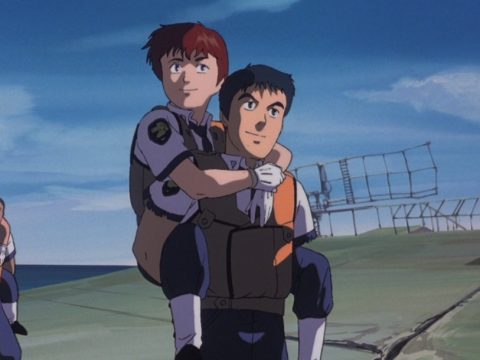
Patlabor’s an ensemble series but the “poster character” is the tomboyish Noa Izumi, a wide-eyed, energetic, and generally capable pilot that loves robots so much she names her Labor “Alphonse” the way she would a household pet. But for all her love of Labors, Noa doesn’t really know much about them. That’s where her partner, Asuma Shinohara, comes in. As the estranged son of the president of one of the largest Labor manufacturers, Asuma knows the capabilities of virtually every commercial Labor there is despite being somewhat unmotivated to achieve. The dynamic between Noa and Asuma is very much like that between Leona and Al in Masamune Shirow’s Dominion: Tank Police, so you shouldn’t expect any outright romance between the two. Then there’s Hiromi Yamazaki, a massive giant of a man who’s also incredibly docile. The running joke of his character seems to be that he has no character: on the rare occasions that Yamazaki speaks he does so rather softly, and he is not typically a focal point of the stories. We know that he likes farming and fishing, but his job is basically to drive the trailer rig that carries Noa’s Labor to the scenes of the crimes. Still, on those occasions where the team needs someone capable of single-handedly holding and firing an anti-tank rifle, “Hiromi-chan” is the man.
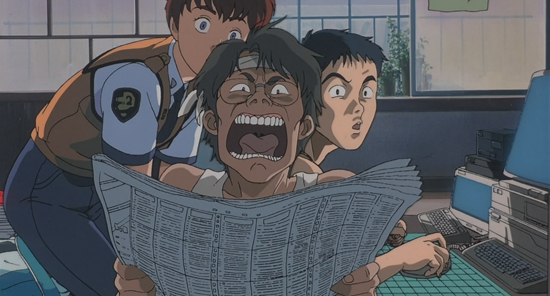
Noa, Asuma, and Hiromi are the more “normal,” straight-laced members of Section 2, Division 2. On the other hand you’ve got Isao Ohta: a short, pudgy, constantly angry gun otaku whose solution to every problem is to ignore all tactical advice, charge straight ahead, and shoot at it using the Patlabor’s trademark sidearm, the “Revolver Cannon.” As the name suggests, it’s an enormous revolver made to fit in the hands of a Labor. Despite his penchant for violence and cackling mania for guns, Ohta rarely ever succeeds in HITTING his targets, resulting in widespread collateral damage that earns Division 2 their reputation of being a bunch of screw-ups. His Patlabor is also the most likely to get wrecked.
The funniest Ohta-centric episode is reminiscent of Mr. Show in its approach to humor. In it, he has a rather “I’m Deckard from Blade Runner”-like dream in which he murders all his teammates, then wakes up with amnesia and a gun in his hand to discover that… he’s murdered all his teammates. (Don’t worry, they get better… eventually.) On the run, he meets a reformed punk formerly known as “Masa the Cold Noodle,” so named because he used to “act tough” by ordering cold noodles year-round then skipping his bill, even in winter, until Ohta, “the Psycho Cop,” put him in the hospital with a severe beating for the crime of ordering cold noodles the wrong time of year. You may be wondering “why do they even let THIS guy pilot a giant robot, anyway?” The answer is “because it’s funny.” Ohta’s partner throughout all of this chaos is Mikiyasu Shinshi, who is completely “whipped” and prone to being ordered around by everyone without sticking up for himself on account of the fact that he’s a married man, but every so often he’ll snap and fly off the handle in a psychotic fit of rage. I would consider Shinshi among the “normal” characters, except he’s MARRIED.
The only person capable of keeping these two in line is Kanuka Clancy. Despite being of half-American/half-Japanese descent, Kanuka looks the most ethnically “Japanese” of anyone in the series. I’m pretty sure this makes Kanuka Clancy the only “half-Japanese American female” anime character ever to NOT have blonde hair, blue eyes, and enormous breasts. Kanuka’s presented as “the perfect cop” in pretty much every way, knowing everything about everything thanks to her photographic memory, but since she’s a member of the NYPD sent to the SV2 as an observer, she’s not tasked with regularly piloting Labors despite her hyper-competence. Instead, she has to babysit Ohta and Shinshi, much to her chagrin. Kanuka is perhaps the most divisive character in the series, thanks to her highly assertive, all-business, take-no-crap American attitude. Personally, I think Kanuka’s one of the best characters, but the Japanese presumably didn’t care for her as much since throughout most of the manga, television series, and OAVs she’s not around. In place of Kanuka is Takeo Kumagami, who exhibits a similar level of acumen as Kanuka while having a more calm, “ideal Japanese housewife”-like attitude about her. One of the more memorable stories is from the second OAV series, in which Kanuka and Kumagami both appear together and each try to assert their superiority over the other in unstated ways like “who can drink more liquor straight” or “who can more effectively defenestrate Ohta from the 2nd story of a building.”
Part of what makes Patlabor stand out from pretty much every other robot anime series is the fact that the Labors aren’t primarily intended for fighting or military purposes. This was one of, if not the first anime to depict robots as everyday tools that served a function in “the real world.” The series manages to strike a balance between “what would robots be like if they were real and put to everyday use” and “robots should still look cool, aesthetically.” As such, whenever our heroes damage their Labors—which look so nifty because they were intentionally designed to have a psychological impact on criminals and civilians alike, okay?—they’ve got to be repaired. The mechanics of the SV2 are their own unique cast of misfits, most of whom go unnamed with two exceptions. The Chief among them is Seitaroh Sakaki, a stern and stoic old man who constantly threatens to throw people into the sea for not working hard enough. Sakaki doesn’t understand computers or software that much, but he adheres to a code of true engineering dedication and makes his entire cadre of mechanic subordinates follow suit; in one of the more notorious episodes that satirizes the Japanese student protests of the 1960s, he declares pornography contraband which ignites a wave of revolutions (and counter-revolutions, and counter-counter-revolutions…). His second in command, Shigeo Shiba (aka “Shige”), is a young bespectacled guy prone to getting incredibly overzealous about, well, EVERYTHING. Shige is voiced by Shigeru Chiba, who ever since being Megane from Urusei Yatsura (Shige is basically the exact same character) and “the crazy hyped-up narrator from Fist of the North Star” has built his entire career around voicing extraordinarily excitable characters. Fans today may know him best as being Emperor Pilaf from Dragon Ball or Buggy the Clown from One Piece.
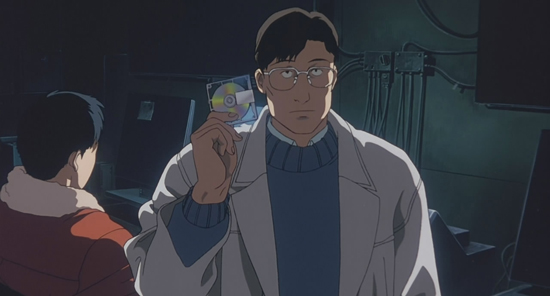
But the one in charge of all THESE clowns is one of the most interesting characters in all of anime: Division 2’s Captain, Kiichi Gotoh. On the surface, Gotoh seems rather calm and laid back at all times, no matter what. But that’s his poker face at work, there to make you unable to get a read on what the guy actually knows or what he’s really thinking. Under the surface, Captain Gotoh is in fact a master at intelligence gathering and deduction, with an intuition only attainable through a keen ability to read and understand exactly how other people think. This also makes him a master when it comes to playing the political game required of being a police captain. Able to manipulate others through words to get them to do what he wants or tell him what he needs to know, the unassuming-looking Gotoh is a cerebral force to be reckoned with. Gotoh carries no gun and requires no physical weapon, for his strongest weapon is his wits. Is he a Zen master? Can he kick your butt using some sort of secret martial art, as his aura suggests? Or is he just the undisputed all-time master of BSing people? Whatever the case may be, when the problems get so big they can only be solved through cunning and intellect, Gotoh takes center stage. His interplay with Division 1’s more by-the-book female captain Shinobu Nagumo, whose underlings you rarely ever see since it’s assumed they’re doing their jobs PROPERLY, is the sort that never seems to last very long in other forms of entertainment let alone anime: one of professional respect and rivalry with a touch of unrequited romance. The closest analogy to Gotoh and Nagumo’s back and forth I can think of is Mulder and Scully from The X-Files, only this time “they’re never getting together” actually holds true. I could write entire essays on the subject of Gotoh’s character and in particular the second film for which he and Nagumo are the primary leads, but it’s best to just see it firsthand.
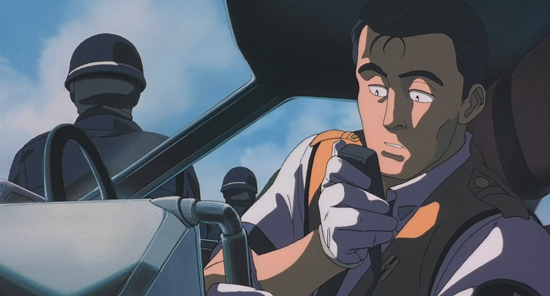
Anime for Patlabor exists in the form of multiple feature films, a television series, and a series of OAVs. All of it was released on DVD in the US, and although they differ in tone and style I recommend watching them all if you can. That’s why it hurts so much for me to note that Patlabor was never as popular among English-speaking anime fans as it deserved to be, and that not only is all of Patlabor years out of print but every single company that has ever released Patlabor no longer exists in its original form, if they’re still in business at all. Even the mighty juggernaut that is Viz only managed to release two out of the 22 volumes of the manga, before being forced to drop it due to lack of sales.
Why? Why did companies choose to release such a series time and again, and why did nobody care for it every single time? I understand the reasons for both completely. It kept getting released because the series really is THAT good, the pedigree of its creators is THAT strong, and it could potentially appeal to a broader audience than just anime fans if not for the fact that at the end of the day, it’s still… a cartoon. And average adult audiences in the US simply don’t want to watch cartoons unless they’re full-on comedies.
Even when it comes to anime fans, Patlabor’s simply not flashy enough for 2010. The animation quality, soundtrack by Kenji Kawai (Eden of the East, Ghost in the Shell), and character designs betray the age of the series. The main cast consists entirely of adults, not teenagers or kids, and none of them is overtly sexualized since everyone wears the same uniform. There is no fanservice, no sex, and no gory violence. Despite all the “action-packed” English trailers, they’re not indicative of the series. In fact, some of them are hilariously inaccurate. Also, and this is not to be underestimated, it has robots in it. You can downplay the significance of that—I certainly have—but for most US anime fans it doesn’t matter. As such, I get the feeling that the only people who will even read this are people who don’t actually NEED to: diehard mecha fanatics who already know about the series and are just chomping at the bit for either validation or to “correct” me on anything I deliberately omitted—notice how I’ve not even bothered to mention the “AV-98 Ingram” or continuity timeline—because that’s how mecha fandom works. Let me save you guys some time: there is no need for you to demonstrate your superior Internet mecha fan kung-fu prowess in the comments, and that overarching one-upmanship mentality among mecha, tokusatsu, and kaiju fans which compels them to do so is a major factor in what continues to drive away would-be fans.
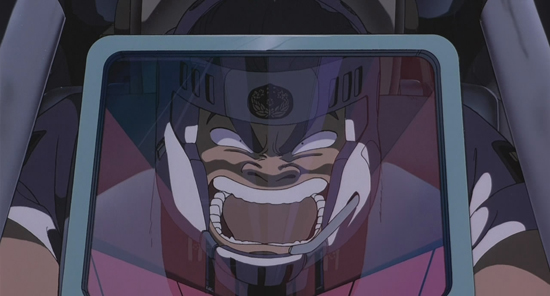
If you’ve never seen Patlabor and would like to get an idea of what it’s like, the two movies directed by Mamoru Oshii still hold up amazingly well and, unlike the TV series and OAVs, have rather admirably-done English dubs. Patlabor: The Movie was the first entry in the franchise ever released in the US and works perfectly fine as a standalone detective story with no prior knowledge necessary, as does the second film. Granted, if you DO know these characters then certain developments in the movies will be far more emotionally significant (the second movie in particular is intended as an ending to the series), but it’s not a requirement. Being a theatrical film, the animation quality is naturally superior to what’s in the TV/OAV series, and the character designs are retooled to look more realistic, a la the difference in artwork between the Rurouni Kenshin television series and the Samurai X: Trust and Betrayal OAV.
Still, be advised that the movies are all serious stories with relatively little action that tend to focus only on certain members of the cast. You probably aren’t going to successfully show them at your local anime club, should such a thing exist, since that type of setting is best suited to high action/comedy. But if you do like it, then getting the rest legally shouldn’t be hard at all if you check online anime retailers ( just search for “patlabor”), with the exception of the original 7-part OAV released here as “The Original Files.” I must confess that even I do not have those on DVD. “The Original Files” was actually the very first Patlabor anime created and does a fantastic job of encapsulating all that’s great about the franchise. The only downsides to it are, as noted, the visual designs and music plus it being quite hard to procure legally. There is another movie entitled WXIII that is sometimes labeled in the US as the third movie, but in Japan this film did not bear the name Patlabor at all in its title since the main characters of the series only exist as background players. That said, the movie is actually a pretty interesting standalone sci-fi detective story in its own right, and you can get the 3-disc set for under $15 these days.
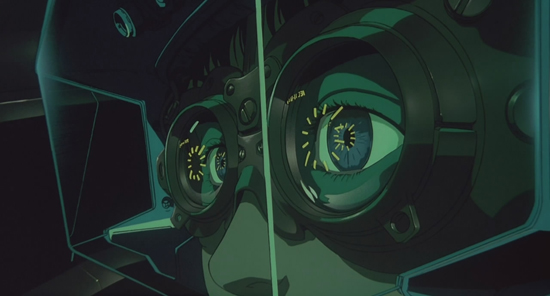
In the 1990s, when I would proclaim to anyone willing to listen that “anime is limitless in the stories it can tell,” Patlabor was the proof. Decades later, it still is. If you like Planetes, any of the anime incarnations of Ghost in the Shell, or the Eden of the East TV series (we’ll pretend the movies didn’t happen), then you owe it to yourself to also watch Patlabor because many of the same people who worked on those were involved with Patlabor first. If you lament the passing of Satoshi Kon (Paranoia Agent, Paprika), then you should know that a key reason Patlabor 2: The Movie looks as good as it does is because he did extensive work on its layouts and backgrounds. If you enjoy 1980s anime romantic comedies such as Maison Ikkoku or Kimagure Orange Road, then I note that the Patlabor TV series was directed by the (possibly dead) Naoyuki Yoshinaga, who directed portions of both of those.
Patlabor may have never been popular and it may never become popular since it’s not easily available unless you’re specifically searching for it. The probability of a remake or sequel, as has become the trend in recent years, is virtually zero since the members of Headgear retain full ownership of their creation and have since moved on. The closing lines of one of the most notable stories from the original OAV series was, “It’s over. It took twenty years to take what began with two people and make it into this… but if you survive, there’s always tomorrow.” Patlabor is indeed over, but there is always tomorrow; forgotten though it may be, at the very least my copies still lie here waiting for the day to come when someone would actually want me to show them. Even though that day will probably never come, their mere presence reminds me of a time when such a series could be actually be produced in Japan and actually be released in America. In the words of the TV series theme song:
So never cry – you know I will always be right there by your side. And so now you can face your future fearlessly.


![SSSS.Dynazenon [Anime Review]](https://otakuusamagazine.com/wp-content/uploads/2021/08/16-9-SSSS.Dynazenon_Key_Visual_3.5-480x360.jpg "SSSS.Dynazenon [Anime Review]")
![Back Arrow [Anime Review]](https://otakuusamagazine.com/wp-content/uploads/2021/07/ba15-02686-480x360.jpg "Back Arrow [Anime Review]")
